
About Kamala
Goddess Kamala, or Kamalatmika, holds the tenth and final place among the ten Mahavidyas, and is a symbol of divinity like the lotus (Kamal or Padma) itself. Also known as Tantric Lakshmi, she is associated with prosperity, happiness, good fortune and the flourishing of a household. She embodies Sattva, and is the goddess of wealth and auspiciousness. Cleanliness and purity are dear to her, and she dwells in such places, closely connected with light — wherever there is no darkness. By contrast, her sister goddesses Alakshmi, Jyeshtha and Nirriti, associated with misfortune, are said to dwell in dark and impure places. Cleanliness and sanctity are therefore essential for Kamala's stable presence. She is worshipped by all beings across the three worlds — gods, demons and humans alike — since all seek happiness and prosperity, which come only through her grace. Without her blessing, poverty, misfortune, disease and strife are said to follow a person, leaving them deprived and despondent. It is said that even Lord Vishnu once found himself without her grace, and as a result all the worlds fell into poverty. She is beloved of Vishnu, and is especially fond of the lotus flower, which is regarded as sacred across Hindu, Buddhist and Jain traditions — rising untouched by the impurity of the water from which it grows, and used in the worship of all deities. Kamala keeps company with the lotus, wears garlands of it, and is surrounded by lotus blooms. She is the consort of Lord Vishnu, sovereign of the world.
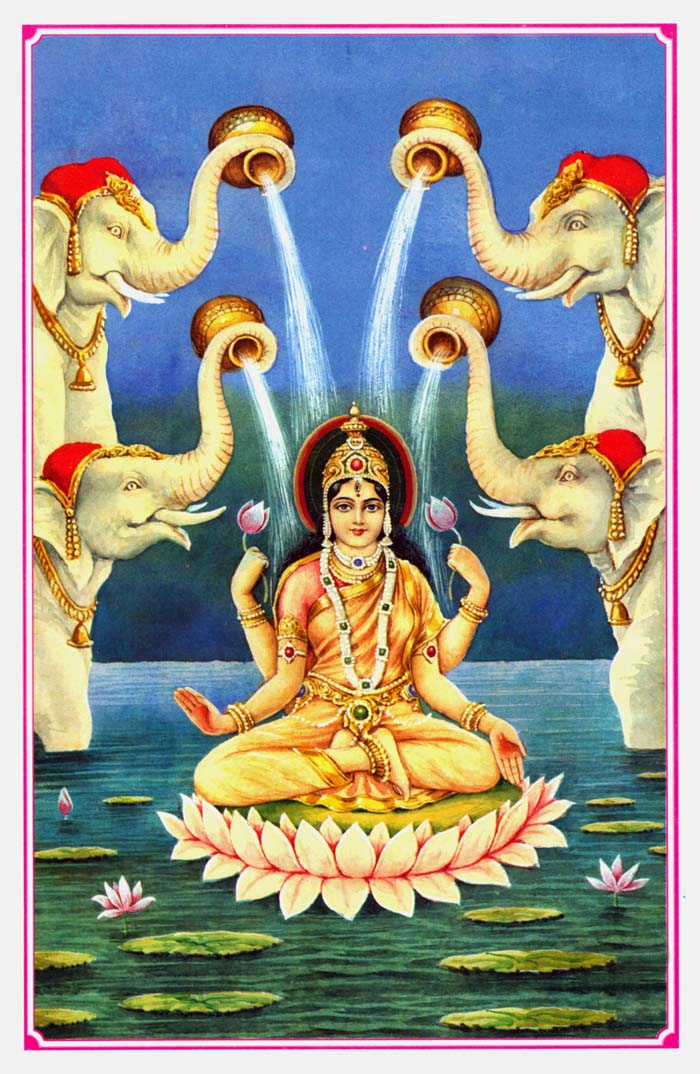
Goddess Kamala is described as exceedingly beautiful, with a golden complexion and a gentle smile. She has three eyes and wears a crescent moon upon her head. She has four arms, holding lotus flowers in her upper two hands while displaying the gestures of blessing and fearlessness (varada and abhaya mudras) with the lower two. She is adorned with precious jewels and a crown set with the Kaustubha gem, and wears fine silken garments. She is depicted seated upon a lotus in the midst of the ocean, surrounded by lotus blooms, while elephants bathe her with pitchers of nectar.
The account of Kamala's emergence appears in the eighth canto of the Shrimad Bhagavatam, connected with the churning of the ocean of milk. Once, due to the curse of the sage Durvasa, the gods lost their fortune and Lakshmi herself departed from Lord Vishnu. To regain prosperity, the gods and demons together churned the ocean in search of treasures, and fourteen (or, in some accounts, eighteen) precious things emerged from it — among them the goddess of wealth, Kamala, and her sister of misfortune, Nirriti or Alakshmi. Kamala went to Lord Vishnu, while Nirriti was given to the sage Durvasa. Upon her union with Vishnu, the goddess became renowned as Kamala-Lakshmi. Thereafter, Kamala undertook rigorous devotion to Sri Vidya Maha Tripurasundari to attain a special place among the Mahavidyas; pleased with her worship, Tripurasundari conferred upon her the rank of a Mahavidya. From that time onward, her connection with wealth, prosperity and happiness has remained complete.
Beeja Mantra

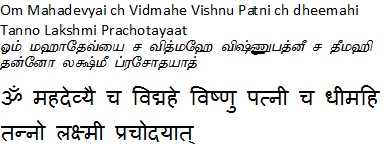
Gayatri