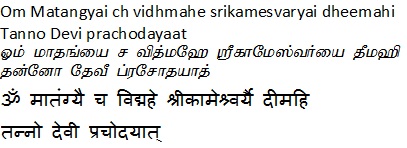
About Matangi
Goddess Matangi holds the ninth place among the ten Mahavidyas. She is closely associated with the Nana tribes, and is also known by names such as Chandalini and Maha-Pishachini. She is regarded as the goddess of speech, music and the fine arts, and is associated with Siddha Vidyas. She has the power to subdue all beings and their enemies across the three worlds through the spoken word alone — a power akin to hypnotism, of which she is regarded as the presiding dynasty. Matangi is connected with nature, animals, birds and forests, and is deeply venerated among tribal communities living in the forest, who worship her through their own distinct traditions and offerings that would ordinarily be considered unconventional or impure elsewhere. She is regarded as the daughter of the sage Matanga, and is also known as Uchishta Chandalini, as no fasting is required in her worship — leftover or non-conventional food offerings are, in fact, central to it. It is said that she was born from the leftover food of Shiva and Parvati, and was first worshipped by Lord Vishnu, who considered her grace essential to happiness, prosperity and high standing. She is also venerated in Buddhism, where she came to be known as Matangi over time. Devotees believe that by her grace, married life becomes auspicious and worldly suffering is eased. She is associated with cremation grounds, ash, bone and the presence of supernatural power in such places, and is regarded in Tantric tradition as a manifestation of Saraswati and the trusted counsellor of Sri Vidya Maha Tripurasundari.
In appearance, Matangi has dark, dusky or black hair, wears a crescent moon upon her head, and has three eyes. She sits upon a jewelled seat adorned with precious gems, dressed in fine ornaments that enhance her beauty; in some depictions she sits upon a lotus. She wears garlands and favours red ornaments and red garments, and appears with the youthful form of a girl of sixteen. She has four arms — in her right hands she holds a veena and a human skull, and in her left hands a sword, while displaying the abhaya mudra (the gesture of fearlessness). She is often shown surrounded by birds.
According to the Pranatoshini tradition, Parvati once asked Shiva for permission to visit her father Himalaya and her mother Mena. Shiva was reluctant to be apart from her, but eventually relented, on the condition that she return to Kailash soon. After some days apart, Shiva, missing Parvati, disguised himself as a jewel merchant and went to the house of Himalaya to test her. He showed her jewels and, when she asked their price, revealed his true intent rather than naming a price. Parvati was angered but soon recognised him through her own powers, and asked the 'merchant' to return after some days. When Shiva returned to Kailash in his true form, Parvati appeared before him disguised as a dark-complexioned, large-eyed maiden. When Shiva asked who she was, she said she was the daughter of a Chandala who had come to perform penance. Shiva, recognising her, blessed her to be worshipped in that very form — as Matangi, born from the Chandala tradition — and granted her many supernatural powers.
Beeja Mantra
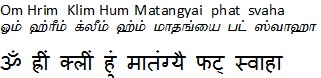
Gayatri